GEN 2 TABLES AND CODES

GEN 2.1 MEASURING SYSTEM, AIRCRAFT MARKINGS, HOLIDAYS


2.1.1 Units of measurement

The table of units of measurement shown below will be used by aeronautical stations within Jeddah FIR for air and ground operations.

2.1.2 Temporal reference system

General

Coordinated Universal Time (UTC) and the Gregorian calendar are used by Saudi air navigation services and in publications issued by the Aeronautical Information Services in Saudi Arabia. Reporting of time is expressed to the nearest minute, e.g. 12:40:35 is reported as 1241.

2.1.3 Horizontal reference system

2.1.3.1 Name / designation of system

All published geographical coordinates indicating latitude and longitude are expressed in terms of the World Geodetic System - 1984 (WGS-84) geodetic reference datum.

2.1.3.2 Parameters of the Projection

Projection is expressed in terms of Universal Transverse Mercator (UTM).
 
For measurement of Units used
Distance used in navigation, position reporting, etc. generally in excess of 2 nautical miles Nautical miles and tenths
Relatively short distances such as those relating to aerodromes (e.g. runway lengths) Meters
Altitudes, elevations and heights Feet
Horizontal speed including wind speed Knots
Vertical speed Feet per minute
Wind direction for landing and taking off Degrees magnetic
Wind direction except for landing and taking off Degrees true
Visibility including runway visual range Kilometers or meters
Altimeter setting Hectopascal
Temperature Degrees Celsius
Weight Metric tons or kilograms
Time Hours and minutes, beginning at midnight UTC

2.1.3.3 Ellipsoid

An ellipsoid is expressed in terms of the World Geodetic System - 1984 (WGS-84) ellipsoid.

2.1.3.4 Datum

The World Geodetic System - 1984 (WGS - 84) is used.

2.1.3.5 Area of application

The area of application for the published geographical coordinates coincides with the area of responsibility of the AIS, i.e. the entire territory of Saudi Arabia as well as the airspace over the high seas encompassed by the Jeddah FIR in accordance with the regional air navigation agreement.

2.1.3.6 Use of an asterisk to identify published geographical coordinates

An asterisk (*) will be used to identify those published geographical coordinates that have been transformed into WGS-84 coordinates but whose accuracy of original field work does not meet the accuracy requirements in GACA Regulations.

2.1.4 Vertical reference system

2.1.4.1 Name/designation of system

The vertical reference system corresponds to mean sea level (MSL).

2.1.4.2 Geoid model

The geoid model used is the Earth Gravitational Model 1996 - (EGM - 96).

2.1.5 Aircraft nationality and registration marks

The nationality mark for aircraft registered in Saudi Arabia is the two-letter group HZ. The nationality mark is followed by a hyphen and a registration mark consisting of a combination of up to three letters or numbers, e.g. HZ - ABC.

2.1.6 Public holidays

Name Date/Day
Founding day 22 February each year
National day 23 September each year
Eid AI Fitr 25th Ramadan to 5th of Shawal
Eid Al Adha 5th to 15th Al Haj month
Weekend Friday and Saturday

Note 1: An AIC will be published at the beginning of each Gregorian year showing the Eid Al Fitr and Al Adha converting to Gregorian dates.
 
Note 2: Some administrative services may not be available and banks and other institutions may not be open during public holidays.

2.1.7 Saudi Arabia National Spatial Reference System (SANSRS)

SANSRS is a consistent reference stem that defines Cartesian coordinates, longitude, latitude, height, scale, gravity and orientation throughout the Kingdom of Saudi Arabia.

A system which allows users to precisely determine and express locations in the kingdom of Saudi Arabia, as well as to quantify changes of the Earth and its gravity field in space and time. 

Designed to meet national economic, social and environmental needs and is used in all applications and services for positioning in horizontal and vertical directions. Also, all existing geospatial products and services are referenced to it. 

In general, the SANSRS consists of the following components:
  • Geodetic Reference Frame (KSA GRF). 
  • Vertical Reference Frame (KSA-VRF). 
  • Geoid Model (KSA-GEOID). 

More information about the realization is provided on the General Authority for Survey and Geospatial Information (GEOSA) website: www.geosa.gov.sa

2.1.7.1 Transformation from KSA-GRF17 to WGS-84

 
Transformation details
Name: KSA-GRF17 to WGS-84(1)
CODE in EPSG: 9383
VERSION: GCS-Sau
Variant: 1
Accuracy (m): 1
Source CRS: KSA-GRF17
Target CRS: WGS-84
Transformation method: Position Vector transformation (geog2D domain)
Method is reversible: Yes
 
Parameter Value Unit Reversible
X-axis transition 0 meter Yes
Y-axis transition 0 meter Yes
Z-axis transition 0 meter Yes
X-axis rotation -8.393 milliarc-second Yes
Y-axis rotation 0.749 milliarc-second Yes
Z-axis rotation -10.276 milliarc-second Yes
Scale difference 0 parts per million Yes

2.1.7.2 Description of the national geoid model KSA-GEOID21

The Mean Sea Level (MSL) correspond to the national geoid model KSA-GEOID21 encompasses the entire Kingdom of Saudi Arabia. The spatial resolutions (equiangular spacing in WGS-84 geodetic coordinates) are as follows:
  • Minimum Latitude: 13° 
  • Maximum Latitude: 34° 
  • Minimum Longitude: 33° 
  • Maximum Longitude: 57° 
  • Latitude Step: 0.020° 
  • Longitude Step: 0.025°

The accuracy of this model is 25 cm.

2.1.7.3 Transformation Between the National Geoid Model and EGM96

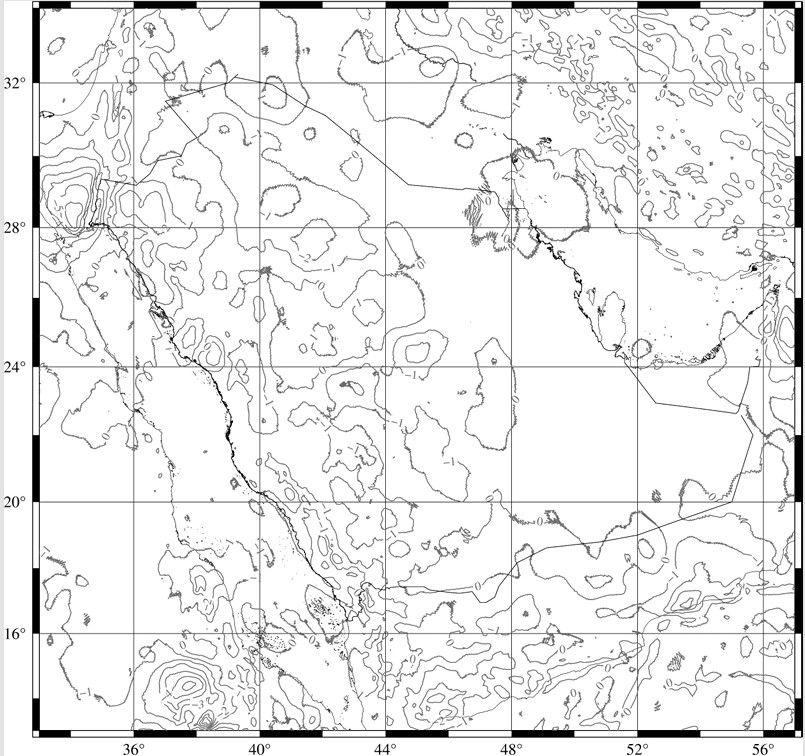
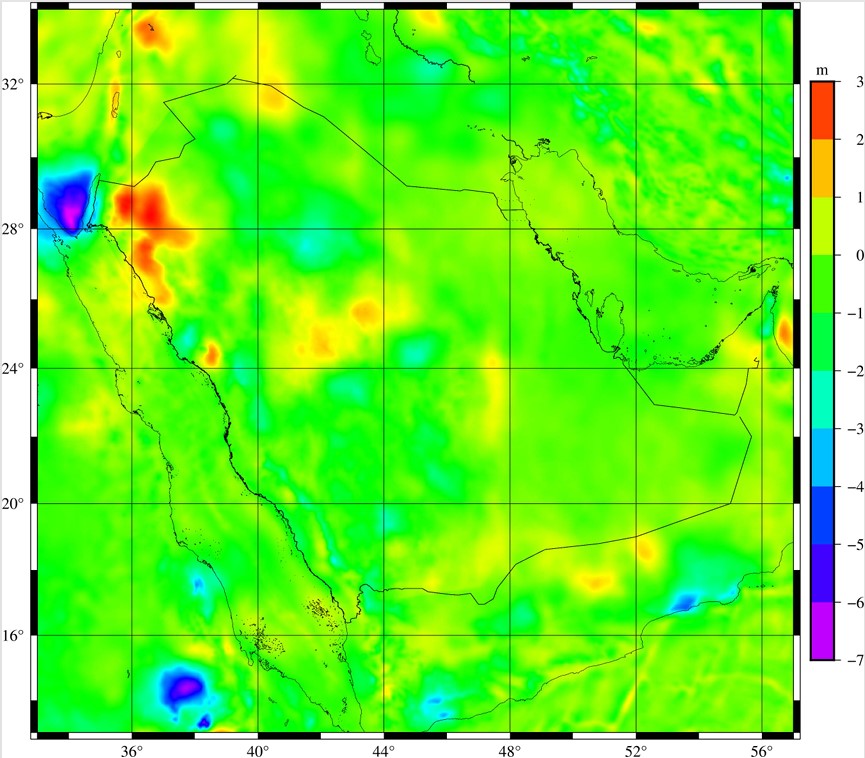
MSL values can be transformed to and from EGM96 using the following transformation grid:

https://aimss.sans.com.sa/assets/FileManagerFiles/Transformation%20grid/KSA-GEOID21_to_EGM96_dms.csv

This transformation grid covers the Jeddah FIR, with rows and columns defined by the geographical coordinates provided in the margin, expressed in degrees and minutes.

To transform MSL values and geoid undulation between EGM96 and KSA-GEOID21 for any given Position is in (Degrees), the height value is in (Meters), use the following formulas:
  • MSL value (EGM96] = MSL value (KSA-GEOID21] - value shown in grid 
  • Geoid Undulation (EGM96] = Geoid Undulation [KSA-GEOID21) + value shown in grid 

Note : The grid of geoid heights expressed in KSA-Geoid2 l and has been calculated, and it differs from the geoid transformation model. These formulas can be applied only to the KSA-Geoid21 - EGM96 transformation grid.